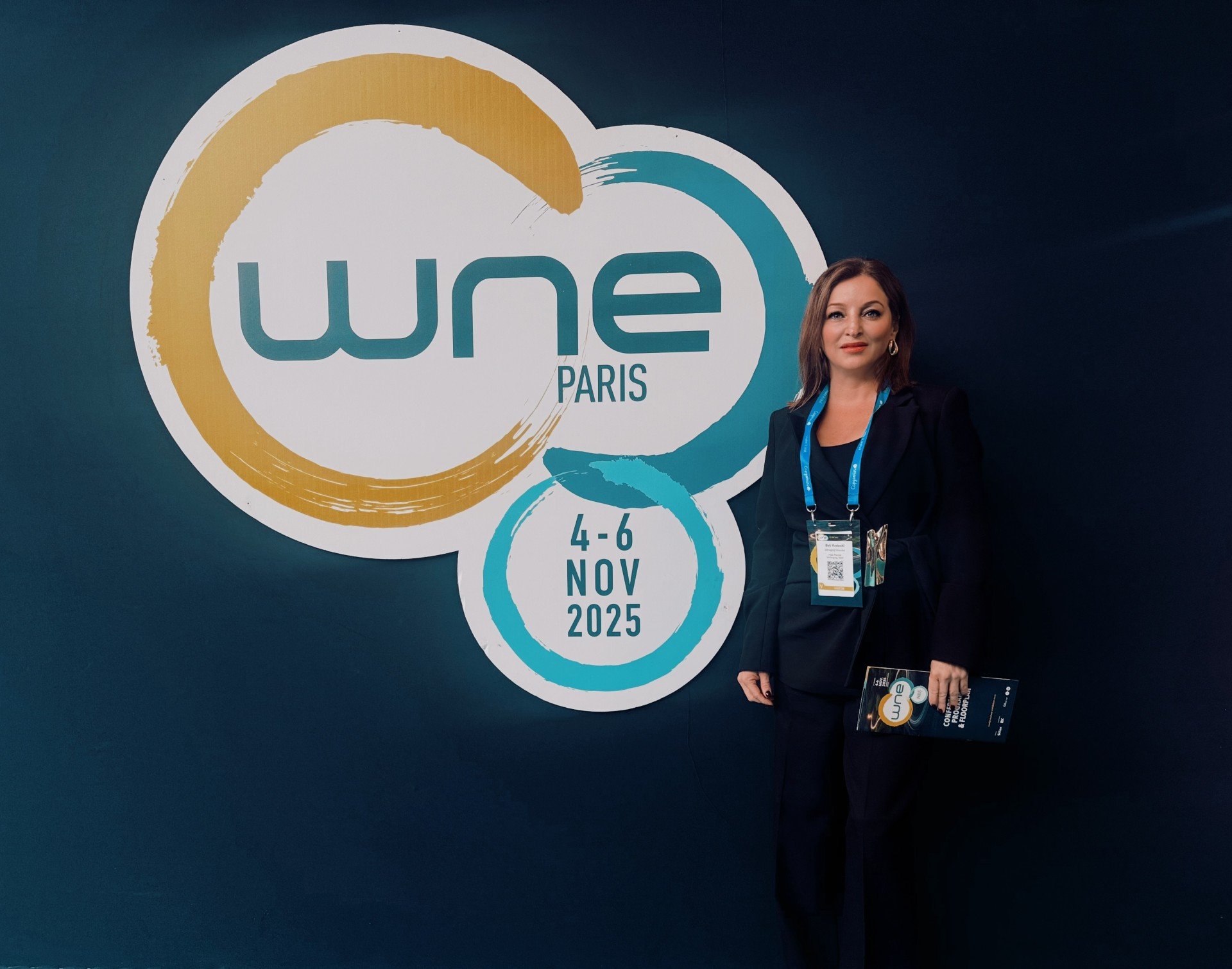
At the beginning of 2025, the last thing on my mind was creating another organisation.
I had just left my role with Industry Capability Network NSW and launched Halo People, my solo entrepreneurial journey focused on helping organisations rethink how capability is accessed, sustained and grown in the globally connected world of work. Moving people and their skills across roles, industries and borders. Supporting capability not as something static, but as something that travels, evolves and compounds.
Then, in late 2025, I was invited to attend the World Nuclear Exhibition in Paris.
Nuclear was entirely unfamiliar territory for me — which, in hindsight, makes perfect sense. I live and work in Australia, where nuclear has long sat somewhere between “off-limits” and “not really part of the conversation.” It wasn’t something I’d encountered professionally or needed to.
So I arrived in Paris curious, open — and largely unprepared for what I was about to see.
Because what I encountered there was not a conference. And not an industry showcase.
It was a fully functioning global ecosystem — already in motion.
Walking into the exhibition felt less like attending an event and more like stepping into a system that had been quietly assembling itself for years. One where industries, workforces, supply chains, capital and technology were already aligned and interacting at scale. A place where the future wasn’t being debated — it was being organised.
And I realised, very quickly, that I had underestimated both the magnitude of what was unfolding — and the implications of who was, and wasn’t, part of it.
Over the three days, I observed.
I walked manufacturing halls and national pavilions showcasing sovereign capability. I met with organisations and their people. I absorbed the interchange across diverse sectors, attending meetings, technical briefings, panel discussions and ministerial updates.
What became clear very quickly was that nuclear-aligned industries are not emerging quietly or tentatively. They are expanding deliberately, visibly, and at scale.
Ninety nations were present, presenting their industries, their workforces, their supply chains, their quality systems, their technology and their capital. The United States, Canada, the United Kingdom, France, Japan, China, South Korea, Brazil, African nations, engaging openly and privately, signing agreements, forming alliances, and building on an already pulsating global capability base.
The scale of coordination was impossible to ignore.
And yet, something felt off.
Absence isn’t announced.
It’s noticed.
It’s felt.
It’s the empty chair you keep expecting someone to take.
Eventually, it became clear whose chair it was.
Australia.
No ministers in the room.
No trade agencies.
No universities.
No policy observers I could find.
No visible representation from our uranium sector.
Not because we lack capability.
Not because we lack credibility.
But because we haven’t organised ourselves to be present.

Naively, I couldn’t immediately reconcile what I was seeing with what I knew.
Halo People had been built on a simple belief: that capability doesn’t live in job titles or organisational charts, but in people — and that when people are supported to move, learn and stretch across roles, industries and borders, whole systems move with them.
Standing in Paris, it became clear that nuclear-aligned industries were no different.
They are not constrained by technology alone.
Nor by any one country’s policy position.
And certainly not by borders.
They are constrained and enabled by the availability, readiness and mobility of people and industrial capability.
What struck me most was that countries with vastly different domestic energy policies were participating meaningfully in the same global system. Some operate reactors. Some do not. That distinction mattered far less than whether their industries, workforces and institutions were organised, visible and ready to transition.
That’s when the contrast became impossible to ignore.
In Australia, nuclear is almost always framed as a domestic energy debate. And to be clear — I’m not an advocate for nuclear power in Australia, nor do I intend to be. That decision belongs to the Australian people and their representatives.
What I witnessed internationally was something far broader: a global industrial and workforce transformation already underway — one that does not pause for domestic consensus before moving forward.
And that’s when it landed.
Australian industry has agency.
Businesses can learn, connect, trade and build capability beyond national borders. Professionals can upskill, work abroad, and return with experience that compounds in value. Supply chains form around trust, standards and delivery not politics.
So, the question that kept circling in my mind was a simple one:
Why not us?
Not as a slogan. Not as defiance. But as a genuine, almost naive question the kind that only surfaces when something suddenly becomes visible.
Through my work with Industry Capability Network, I had seen firsthand how urgently Australian industry needs new pathways for growth new markets, new partners, new arenas in which to innovate and compete.
And here was one.
Real. Established. Expanding.
Aligned with capabilities we already have.
ANWIN became my answer to that question.
Not to force participation.
Not to dictate outcomes.
But to ensure Australian industry has the visibility, connections and choice to decide whether it wants to step into this global ecosystem or not.
Because the opportunity exists.
The commercial logic exists.
And the capability if we’re honest already exists too.
What was missing was the connective tissue.
And that is why ANWIN exists.
I refuse to accept that Australia’s role in the future is limited by inertia.
Industry has both the freedom, and the responsibility to engage globally, learn boldly, and prepare seriously, even when policy has yet to catch up.
ANWIN is the platform I have chosen to build for that purpose an international connective network designed to help Australian organisations understand where global nuclear-aligned demand is forming, how Australian capability maps into that demand, and what readiness truly looks like.
This matters because the global nuclear ecosystem is no longer confined to power generation. It now spans advanced manufacturing, defence, digital infrastructure, medical science, critical minerals, robotics, quality systems, data centres and clean industrial processes. These are sectors where Australia already has depth.
At the beginning of 2025, I was focused on helping people move across careers and borders.
By the end of it, I understood that some industries need the same intervention.
So, this is not an announcement.
It is a line drawn.
ANWIN is here.
I’m here for it.
And the work has already begun.
If you see what I see, you already know this is the moment to step in — not stand back.
ANWIN exists to create more options.
For businesses ready to look beyond traditional markets.
For professionals seeking globally relevant experience.
For institutions that understand workforce and capability development is a generational task.
This is an invitation — not to agree, but to engage.
The system is forming.
The work is beginning.
And 2026 is the right moment to step forward together. Join me!
- By Beti Krsteski, Founder, Australian Nuclear Workforce & Industry Network (ANWIN)